Ezra is talent management software built for beauty, fashion, and lifestyle agencies. It turns each creator's live Instagram, TikTok, and YouTube data into designed, accurate, on-brand media kits, pitches, contracts, and campaign reports, held to a luxury editorial standard, so an agency can present its roster to the fashion houses and beauty brands its creators actually work with, at the standard those brands hold. The outcome an agency buys is simple: win and keep better talent, and close better deals.
An agency's real product to a brand is credibility and fit. Ezra protects both, and does the administrative work behind them, so the manager directs the work instead of doing the busywork.
1. Win and keep the talent you want
Premium talent signs with, and stays with, the agency that presents them best. When a manager can show a prospective creator a media kit and pitch that already looks like it belongs next to a luxury campaign, the agency wins the signature. When every creator on the roster is presented to the same elevated standard, they have no reason to leave.
How Ezra delivers it
- An editorial design system, not customizable templates. Controlled typography, colour, and generous white space, constrained so output stays on a beauty and fashion editorial standard and never drifts into a generic look.
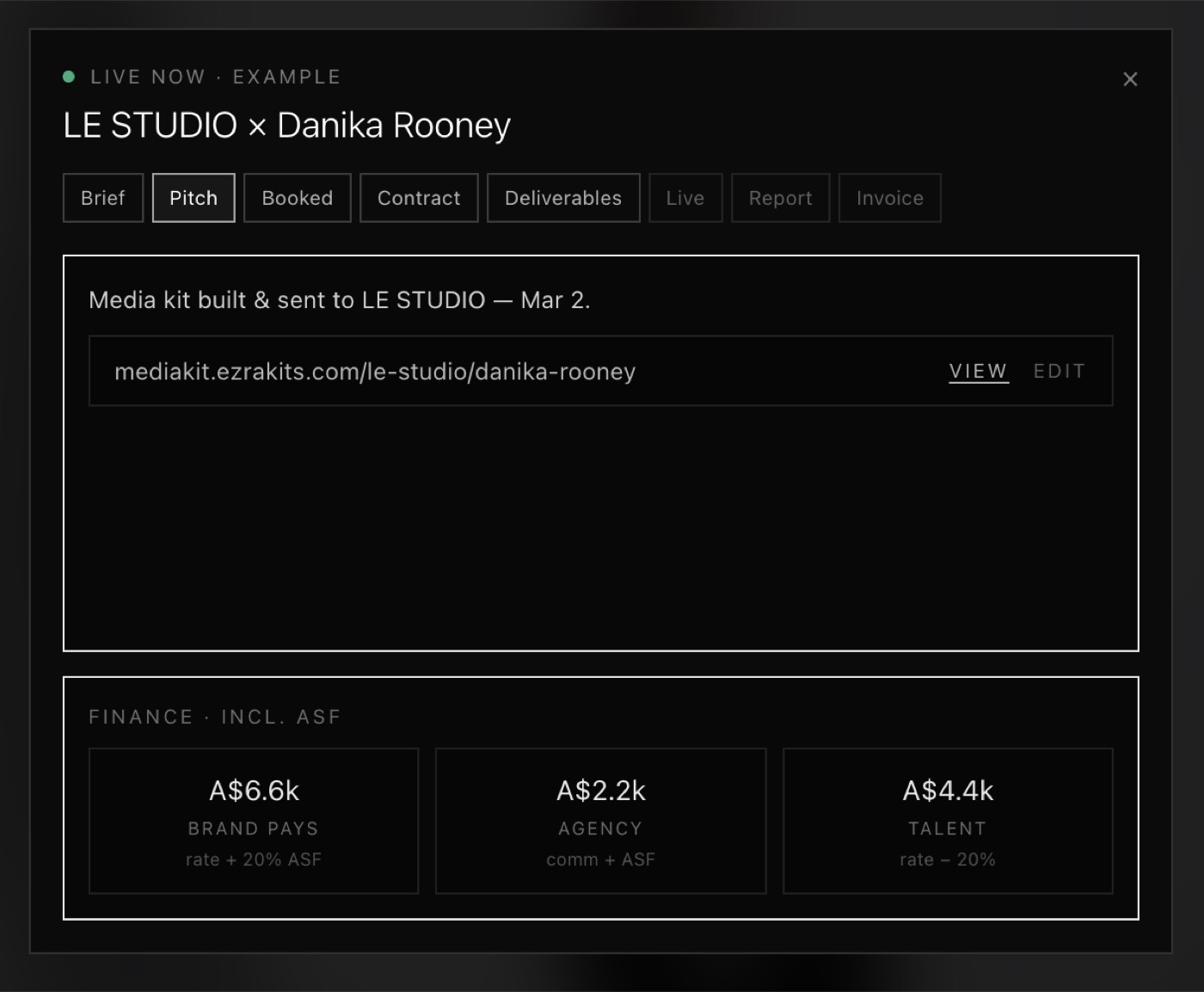
- Served on the agency's own white-label domain. Kits, proposals, and reports live at the agency's address, for example mediakit.youragency.com. Ezra generates a clean, descriptive URL from the name of each pitch or kit, and the manager can edit the slug to anything they want, so the link reads exactly how the agency wants it to.
- Roster-wide consistency. Every creator's kit, bio, and pitch carries the same considered standard, so the whole roster reads as a premium house, not a folder of one-off documents.
A roster that looks like the agency, held to a standard talent does not want to leave.
Aesthetic first
Shown for demonstration. Public kits and reports that display connected-account insights are kept out of search engines by design, so this is a presentation sample.
2. Close the brands that judge you on taste
In beauty, fashion, and lifestyle, the presentation is the pitch. A link-in-bio aesthetic undercuts the talent the moment it lands in front of a brand that lives on how things look. Ezra's design system is built by people who understand fashion and entertainment, and the difference between a heritage house, a quiet-luxury label, and an avant-garde one. So the artefact you send matches the brand's own standard, which is what gets the pitch taken seriously and shortens the path to yes.
How Ezra delivers it
- Pitches and proposals designed to a luxury editorial bar across desktop, tablet, and mobile.
- Brief-matched relevance. Moxy reasons over a standing analysis of each creator's work to match a specific creator to a specific brand brief, so the pitch leads with fit, not a generic deck.
- Group pitches across several talent at once when a brief suits more than one creator.
Pitches that read like they belong next to the brand's own campaigns, so more of them convert.
3. Charge what the talent is worth, and prove it
Agencies leave money on the table when they cannot defend a rate, and lose renewals when they cannot prove what was delivered. Ezra puts defensible, first-party data on both ends of the deal, so you set the rate with confidence and keep the brand by showing the return.
How Ezra delivers it
- Live data pulled from Instagram, TikTok, and YouTube through official APIs. Never typed in, never invented. Numbers a brand can trust.
- Earned Media Value as the proof currency at both ends: justify the rate going in, and prove delivered value coming out.
- Campaign reports that re-analyse the delivered content, not just view counts, with a per-creator and per-post read of what drove the result and what to do next round.
Set the rate, defend it with first-party data, and win the renewal by proving the return.
Proof, not promises
Shown for demonstration. Public reports that display connected-account insights are kept out of search engines by design, so this is a presentation sample.
Every report prices delivered work in Earned Media Value, calculated conservatively and shown beside the real reach and engagement it came from.
4. Scale the roster without scaling headcount
The ceiling on most agencies is manager hours. Kits, pitches, rate cards, contract reads, and reports are the midnight work that caps how many creators and deals one person can carry. Ezra removes the admin so a single manager can run a larger roster and more deals at the same standard.
How Ezra delivers it
- Moxy does the assembly and analysis in a single pass, then hands the finished asset back for review. The manager edits and approves a finished thing rather than building from scratch.
- One standing analysis per creator, kept current automatically, so the work is ready when a brief lands rather than started from zero each time.
More deals per manager, at the same editorial standard, without adding staff.
5. Protect every brand relationship
One off-tone pitch or a missed exclusivity clause can cost an agency a relationship it spent years building. Ezra is built so the manager always stays in control, with the busywork that creates risk handled and surfaced rather than skipped.
How Ezra delivers it
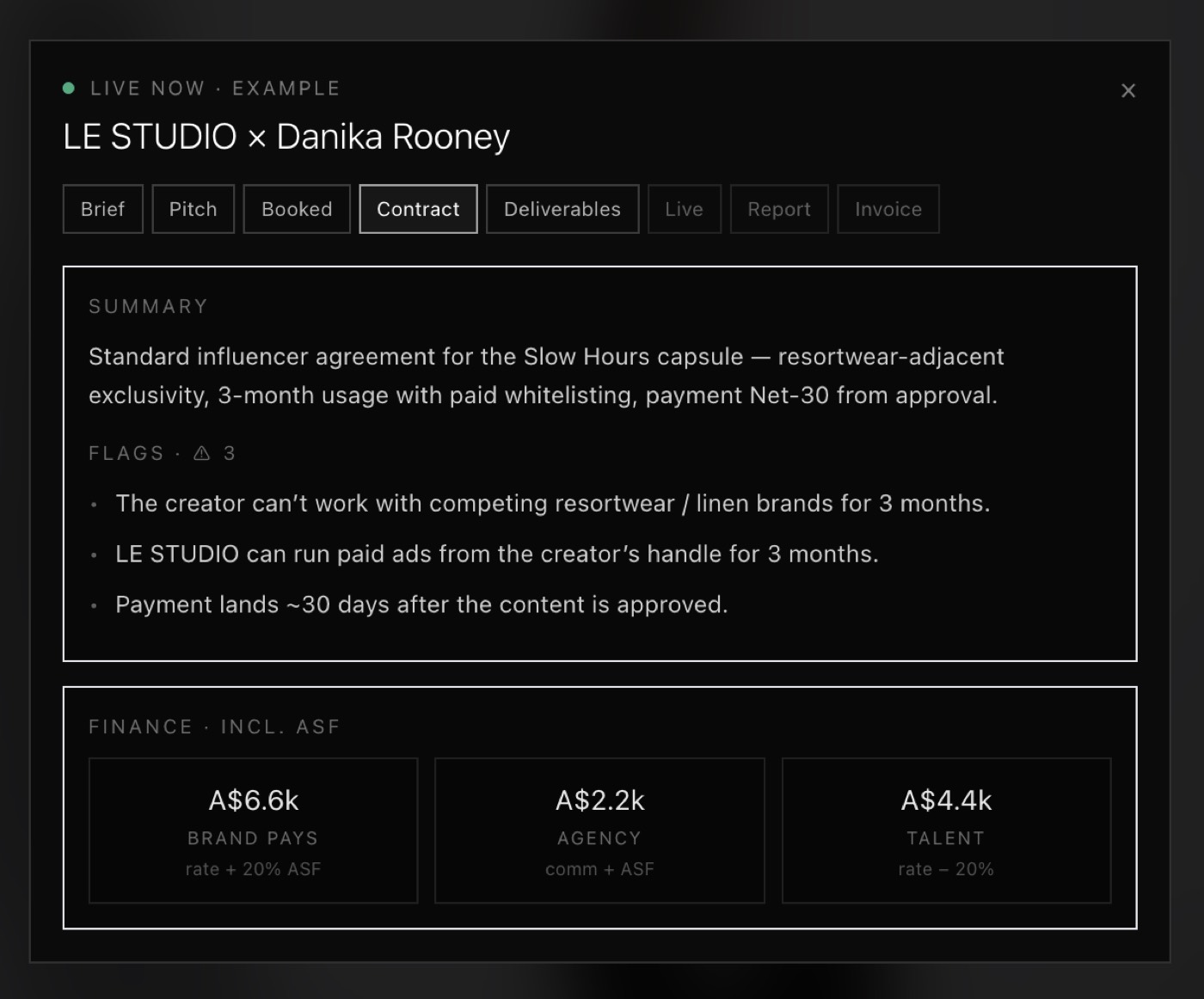
- Contract review that flags exclusivity conflicts and usage-rights issues with a citation to the specific clause. It raises the issue rather than blocking the deal.
- Exclusivity and usage-rights tracking across the roster, so no creator is pitched into an active exclusivity window.
- Per-kit password protection. Any media kit, pitch, or report can be locked behind a password, so confidential pitches and private brand work stay private.
- Compliance by design. Assets that show connected-account insights are kept out of search engines, and the manager is always the author. The admin, not the art.
The manager stays the author, and the relationship stays protected.
Meet Moxy
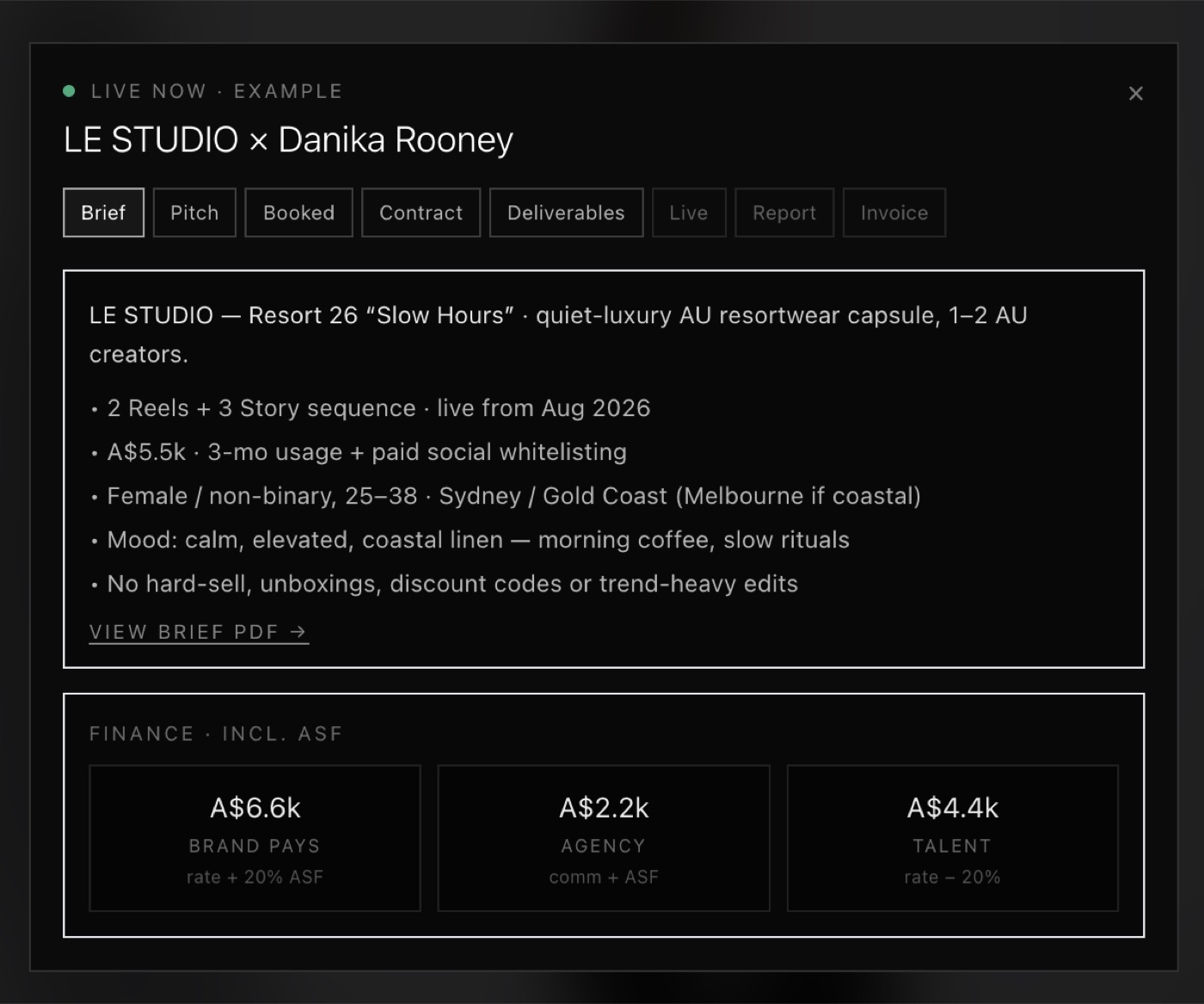
Moxy is the in-product agent that does the work behind every outcome above. Give her a brief and she goes from brief to a finished media kit, brand proposal, or pitch in a single pass: she reads the brief, reasons over each creator's standing analysis and verified partnership history, pulls live Instagram, TikTok, and YouTube data, shortlists the talent that fits with proof, designs the assets on brand, sets and justifies rates, reviews the contract with clause-level citations, and produces the campaign report at the end. The manager keeps editorial control throughout.
The standing analysis is what makes the match different from a generic deck: Moxy already understands each creator's body of work and verified partnership history before a brief ever lands. For a closer look at how that works, read what Moxy knows before the brief lands.
Watch Moxy run the deal, end to end
Two tiers of autonomy, stated honestly
- Today. Moxy works autonomously the way a strong agent does. Give her one instruction and she executes the whole multi-step job, then hands you the finished asset to approve. You stay the author, and you review everything before it reaches a brand.
- Coming next (early access, in development). Moxy running on her own initiative across a roster, picking up and progressing campaigns without being asked, with the manager setting the guardrails. Ezra is opening early access to this, including via MCP, so agencies can run Moxy inside their own workflows.
Today, Moxy turns a brief into a finished media kit, pitch, and report in a single pass, with the manager reviewing every asset before it reaches a brand. We are now building toward Moxy running campaigns more autonomously, and opening early access to that, including via MCP.
How Ezra compares
vs Canva. Canva is a manual, general-purpose design tool producing static documents you type numbers into. Ezra is an agent that builds living, editorial kits from live data, specialised for one industry. Canva is broader and cheaper for generic design. Ezra is the editorial standard for beauty, fashion, and lifestyle talent.
vs Beacons. Beacons is a broad, all-in-one commerce and management platform across every niche. Beacons is broader on commerce and monetization. Ezra is the specialist editorial layer for beauty, fashion, and lifestyle, with deeper design craft and live content analysis.
vs Foam. Foam offers drag-and-drop media kit microsites. Ezra adds an editorial design standard, live multi-platform data, and the full brief-to-report agent workflow.
vs Linktree. Linktree is a generic link list. Ezra builds an editorial link-in-bio and imports an existing Linktree or Beacons into a designed, on-brand bio in one step, on the agency's own domain. Linktree is simpler and broader. Ezra is the editorial bio built to the agency's standard.
Who it is for
Ezra is built for talent and management agencies in beauty, fashion, and lifestyle whose creators are judged on aesthetic, and who pitch the brands that judge talent on how things look, from heritage houses to the avant-garde. If presentation is how you win talent and close deals, Ezra is the production layer built for that standard. Trusted by premium beauty, fashion, and lifestyle talent agencies.
Frequently asked questions
- What is talent management software for an influencer agency?
- It is software that helps an agency present, pitch, and prove its roster of creators to brands. For beauty, fashion, and lifestyle agencies, Ezra does this to a luxury editorial standard, building media kits, pitches, contracts, and campaign reports from live Instagram, TikTok, and YouTube data, with the manager keeping editorial control.
- What outcome does an agency actually get from Ezra?
- Better talent won and retained, more deals closed with the brands that win on taste, rates set and defended with first-party data, renewals won by proving delivered value, and a larger roster run without adding staff.
- How is Ezra different from a design tool like Canva?
- Canva is a manual design tool you type numbers into. Ezra is an agent that builds living, editorial kits from live, first-party social data, specialised for beauty, fashion, and lifestyle, with a brief-to-report workflow that a general design tool does not have.
- Does the agency stay in control of what gets sent?
- Yes. Moxy assembles and analyses, then hands the finished asset back to the manager to edit and approve. Nothing reaches a brand without the manager's review. The admin, not the art.
- Where does the data come from?
- Live Instagram, TikTok, and YouTube data through the official APIs. It is never typed in and never invented, which is what makes the numbers defensible when you set a rate or prove a result.
- Does Ezra white-label to the agency's brand?
- Yes. Media kits, proposals, and reports are served on the agency's own white-label domain, for example mediakit.youragency.com, designed in the agency's standard. Ezra generates a clean, descriptive URL from the name of each pitch or media kit, and the manager can edit the slug. Each kit can also be password protected when a pitch needs to stay private. Every asset sits at the agency's address, not Ezra's.